 A little spring snow deters him not at all.
 A junco perches within the safety of the garden.
 Snow gilds the queen anne's lace.
 A lovely spring garden.
 Junco has flown into the oak tree, everyone's favourite place to sit.
A little spring snow deters him not at all.A junco perches within the safety of the garden.Snow gilds the queen anne's lace.A lovely spring garden.Junco has flown into the oak tree, everyone's favourite place to sit.
Junco has flown into the oak tree, everyone's favourite place to sit.
A little spring snow deters him not at all.A junco perches within the safety of the garden.Snow gilds the queen anne's lace.A lovely spring garden.Junco has flown into the oak tree, everyone's favourite place to sit.


 Quietly, behind my back, the grapes grew.
 So I picked the grapes, about four and a half gallons once I took them off their stems.
 Today he picked the ripe-enough apples that might blow down, and I picked more beans, since their brittle plants are likely to blow away,
 and the basil, since it could get smashed too.
 The tomatoes dangling greenly I leave in the hand of God. The kitchen is ready for Greg to turn it into an applesauce and pesto factory tonight. I'm sure it's pesto and applesauce the authorities mean when they talk about storm preparation.
 We don't need to worry about losing power. There will be plenty of wind for the turbine.
 And -- all on their own initiative, I might add -- the hens have decided to go on hurricane watch. They have taken up a strategic position from which they are staring in three directions for signs of Earl. When the last hen has laid her day's egg, she'll join the guard. Her assigned position will be looking east, so I think she will miss all the excitement.
 The horizontal cross bar on one of the trellises -- an eight foot long 2"x 2" milled from island spruce -- sagged and sagged until at last it snapped in half under the weighty morass of twisted vines, spreading leaves and dangling beans. I don't care, though.
 Every other morning I work my way around this trellis, parting a dense jungle of leaves and dodging bees to peer as deeply into bean world as I dare. The challenge is making sense of such manic, burgeoning complexity. I can only see parts of beans amid fractured shards of shadow and sunlight. They are rarely dangling properly as they are supposed to, more often wedged up behind the trellis netting or lolling across a twisted bunch of leaves. Some of them do hide in plain sight, growing larger and larger until even the most distracted seeker could find them, gigantic foot-long beans, cartoon beans, beans guaranteed to get your attention no matter what.
 I begin my every-other morning bean harvest with a slow, patient, systematic search for normal-size beans. Be mindful, I tell myself. Be Zen-like. Appreciate the beans. Let the beans be your teacher. But pretty soon my disciplined approach breaks down into something primitive, Lord of the Flies-ish. Even though it's early, the garden is hot, and there are mosquitoes about, and my hands have a mind of their own. Half way around the trellis they assert themselves, not at all mindfully. Whatever they locate by accident, they take. Whatever they miss, they miss and don't even know it. My hands are in a hurry, and greedy. They are focused on the bottom line. So many beans! they think. Let's get this over with. My hands get impatient and they don't look back.
 I try to imagine what that journey is like from a butterfly's point of view. But I can't grasp it. It's beyond me in so many ways.
 It gives me an excuse to wander around surrounded by the sound of a hundred bees humming away.
 They've been hard at work in the garden all summer long. Just because the season is turning slowly toward fall is no reason to change their ways as far as they are concerned. There's still lots for them to do.

 The wild bees take care of everything. They don't make honey so humans don't think they are just the end-all and be-all. But humans can be short-sighted that way.
 There's a Grimms Brothers tale called The Queen Bee. The youngest of three brothers, who was dwarfish and insignificant, followed his two older brothers out into the world.
 He may have been insignificant but he was kind. Maybe his own dwarfishness gave him empathy for other small creatures.
 In three episodes of the story, he defended first ants, then ducks and finally bees against the cruelties of his brothers.
 Then came the tests to break the spell on an enchanted castle and win the hand of the princess.
 They were quite impossible tests.
 But the grateful ants, ducks and bees came to the aid of the youngest brother and so he was able to accomplish them all, even though his older, stronger, and no doubt more handsome brothers failed.
 It's one thing to admire it along a roadside but something else to watch it up close every day. I never knew it had so many lovely stages of development.
  Its tiny flowers blush pink as they open.
 I have only seen the small wild bee sipping nectar here, and small flies. The larger bees don't seem to visit.
 Each fully opened flower -- made up of a myriad of tiny blossoms -- has a dark red heart at its centre. It fades away as the flower matures.
 They have a graceful sculptural quality. Strong wind does not affect them, as they only bend and sway.
 And they have a delicate sweet fragrance. I never knew that. These flowers remind me that the more I look the more I see.

 This year the honeysuckle is doing beautifully. I'm glad that it's a honeysuckle that's native to Atlantic Canada.
 In the meantime, the honeysuckle is flourishing over at the old hotel, in places where no lamb could ever safely go. High up in a spruce tree, for instance. Deep down in the ancient cellar.
 A contrast.
 Some tiny story, maybe of how a vine can plant itself in nothing and blossom where you least expect it, or will keep coming up year after year even when everything around it has collapsed and even when there's nobody left to admire it.
 Though we are admiring it now.
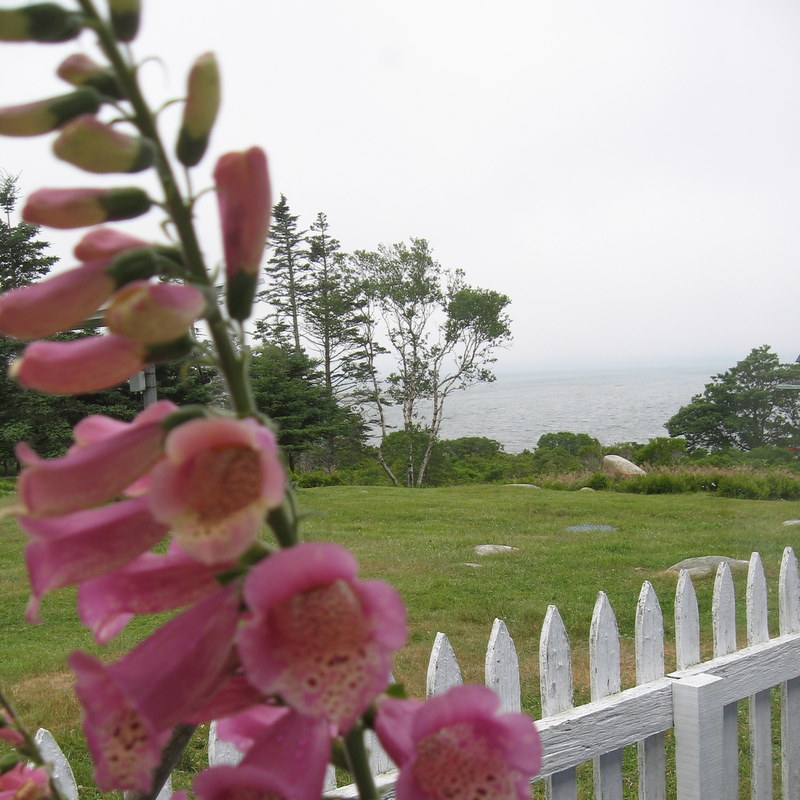 Yesterday they swayed back and forth like the masts of a ship in a storm at sea.
 A bee flew round and round, trying to decide which flower he liked the best.
 He just couldn't make up his mind. They all seemed so -- beckoning.
 I imagine the range of choices and all that swaying was making him a bit woozy.
 But he kept going, true to his beeness no matter how great the challenge.


.gif)
